Creating Advanced Material Solutions
We love solving complex, technical problems. It’s a habit formed by years of academic research and built upon by contracts with numerous federal and private organizations. Today, we develop solutions for industries including aerospace, energy, and defense.
Our interdisciplinary team of physicists, engineers, and builders achieves success through creative ideation and intense technical validation.
We leverage our expertise in metamaterial composites to design material solutions that not only solve important problems, but do so by providing unique advanced functionality.

Technology Development
Federal Contracts & Awards
Partners & Accelerators
- Ansys
- Dawnbreaker
- FedTech
- Larta Institute
- Lever
- MassChallenge
- Massachusetts Clean Energy Center
- StartUp Worcester
- Massachusetts Manufacturing Innovation Initiative (M2I2)
- Venture Forum
Metamaterial Composites
More than the sum of their molecules
Multiscale Systems is the expert in metamaterial composites, a structural material that unlocks advanced functionality that’s difficult or impossible to create with normal materials.
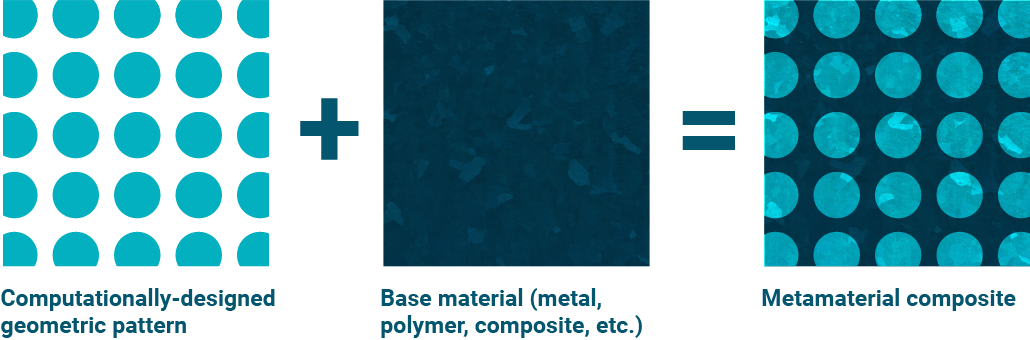
Metamaterials are common materials – like metals, polymers, and composites – formed into computationally generated, complex geometries. These geometries are tailored to each application, designed to provide enhanced performance and unique functionality.
Inspired by origami’s process of folding flat sheets into three-dimensional forms, metamaterial composites can be made using familiar manufacturing methods, such as additive manufacturing, thermoforming, and pattern transfer. Advanced functionality manifests through the unique combination of selected materials and patented geometric patterns.
Lightweighting Plus
A major benefit of metamaterial composites are their low density, but lots of materials – foam, honeycomb, other composites – are lightweight. The “plus” comes from the ability of metamaterials to be made with commodity resins, produced with scalable manufacturing methods, and readily integrated into existing products.
Thermal and mechanical stress compensation
Metamaterial composites maintain structural integrity while expanding or softening as required. They can replace materials like elastomers where environmental conditions are too extreme for long-term survivability.
Thermal management
Avoid the trade-offs with insulating materials like foams, wools, aerogels, and vacuum insulated panels. Metamaterial composites are cost effective, can be designed with high R-values, and offer better shear strength and increased material life span.
Auxetic properties
Auextic means a material will grow when pulled and shrink when pushed. Press-fit options for metamaterials could benefit a range of industries, including building construction where spray foam is unreliable and suffers long-term compressive strength degradation.
Acoustic engineering
Metamaterial composites can start as a flat sheet which then has curves or creases built into it. This shape can be conformed to architectural surfaces and have a texture that promotes acoustic dampening or sharpening.
Part consolidation
Multiple objectives can be performed simultaneously, reducing the number of parts and assembly time required. An example would be an electric vehicle battery box that’s structurally lightweight with a built-in cooling system.
Patented geometries are applied to common base materials, endowing them with advanced functionality.
This “equation” can be visualized as: